


In relationships, we often develop patterns of communication-both in daily interactions and during conflicts. These patterns can cause us to unconsciously fall into roles within what is known as the Drama Triangle-a dynamic that rarely benefits our relationships. This applies to our romantic relationships, friendships, and family connections.
The Drama Triangle was developed by Dr. Stephen Karpman in the 1960s as a social model for human interaction. It consists of three roles, each of which avoids responsibility for personal needs and boundaries in different ways. While these roles may feel familiar and even safe, they often reinforce unhealthy dynamics. Furthermore, when one person attempts to break free from the triangle, the other person may unconsciously resist the change, pulling them back into the pattern.
The Drama Triangle
Note: The Drama Triangle and Empowerment Triangle are fascinating and complex when explored in depth. Here, they are presented in a simplified way for easier understanding and practical use.
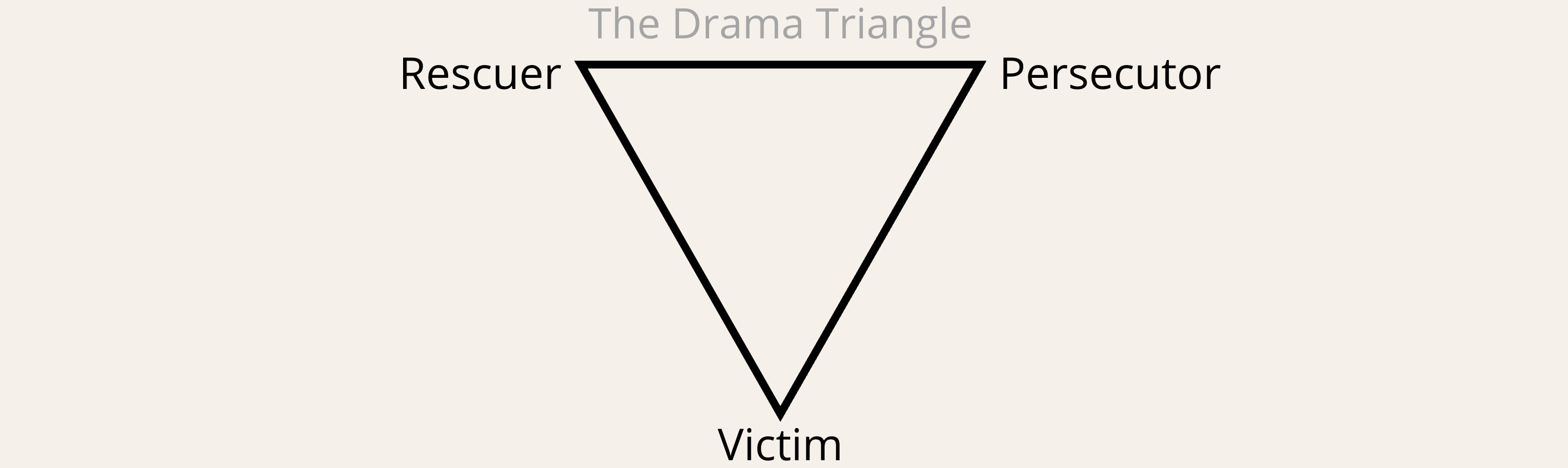
Victim: Feels helpless, powerless, or blames others for their struggles. They often believe they can never catch a break and feel safest when they don’t have to take responsibility for themselves.
Rescuer: Overcompensates by trying to “fix” or save others, often ignoring their own needs-a behavior sometimes called the savior complex. They take on others’ problems as their own, which allows them to avoid looking at their own life-sometimes a chaotic or painful one. The Rescuer’s underlying emotion is often loneliness, which is alleviated when others need them. Being needed makes them feel important. However, Rescuers tend to focus on relieving immediate pain in the Victim rather than addressing core issues.
Persecutor: Criticizes, blames, or acts defensively, often using control or anger to mask vulnerability. They can be self-righteous and believe they must win at any cost. Their mindset is often: They are wrong, I am right, so they need to do what I say. Persecutors blame the Victim and criticize the Rescuer’s behavior without offering appropriate guidance, assistance, or solutions.
In a single conversation, it’s possible to jump between these roles, even within the same sentence. To truly understand this dynamic, it’s important not only to recognize it but also to work toward breaking free from it.
You can break away from the Drama Triangle by adopting the Empowerment Triangle. This approach emphasizes taking responsibility for your needs and boundaries while fostering healthier interactions.
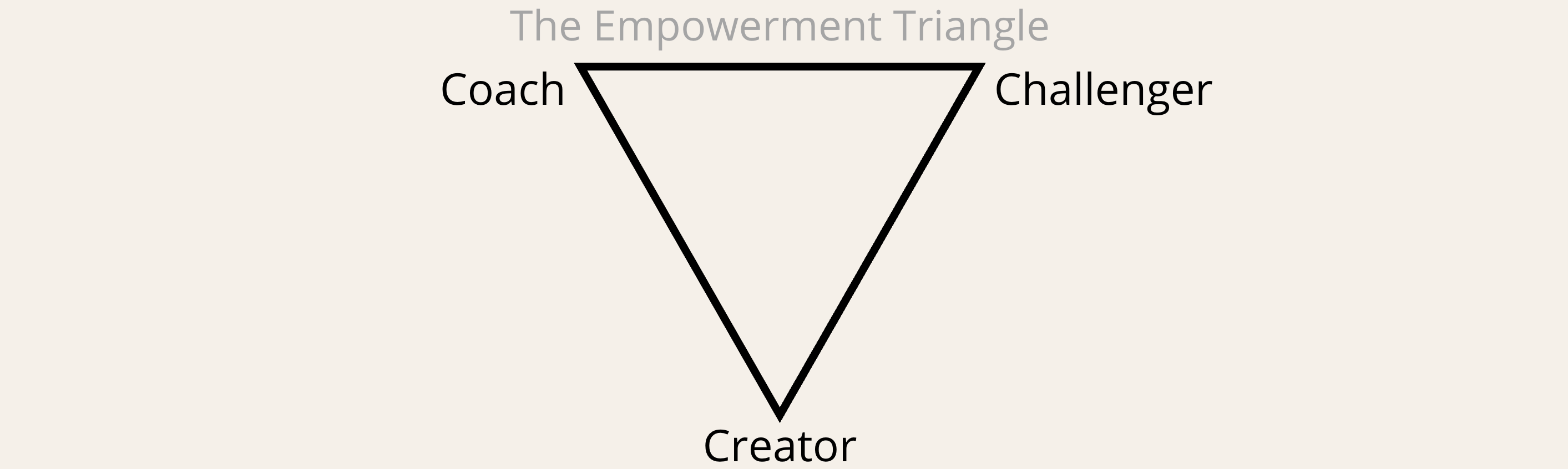
Creator (Countering the Victim): Focuses on what they can do to improve their own situation, taking ownership of their actions. Creators see life through a lens of possibility and take charge of their own growth. While the Victim tends to dwell on past deficiencies, the Creator looks forward, taking an optimistic approach. They believe they are sufficient, whole, and capable of choosing their responses to life.
Coach (Countering the Rescuer): Offers support and guidance without taking over or fixing others’ problems. A Coach supports the Creator for the Creator’s own good—not for validation, as the Rescuer might. Coaches set healthy boundaries and lead by example. One key difference between a Rescuer and a Coach is listening instead of telling. A Coach helps create a space where the Creator can find insights, trusting that solutions will emerge when the Creator is ready. Rather than trying to fix the Victim, the Coach waits, listens, and trusts the process.
Challenger (Countering the Persecutor): Encourages growth by addressing issues directly and kindly. Challengers care about the Creator’s development, but unlike Coaches, they are more direct. They are committed to their values and see themselves as truth-tellers, sometimes saying what is unpopular. However, unlike Persecutors, Challengers focus on the issue, not the person. Their approach fosters learning and growth in a way that feels safe and constructive.
Working with the Empowerment Triangle means empowering yourself, standing by your needs and boundaries, and encouraging the same in others.
Step 1: Understand
The Drama Triangle & The Empowerment Triangle
Spend some time discussing the Drama Triangle and the Empowerment Triangle. Make sure you understand their dynamics.
Step 2: Experience the triangles in practice
Before applying these concepts to personal experiences, start with a guided role-play. This exercise will help you observe how the roles in both triangles interact and influence the dynamics of a conversation.
Role-Play Exercise:
Act out the roles of Victim, Rescuer, and Persecutor using the provided scene below.
Then, continue the exercise using the Empowerment Triangle roles (Challenger, Creator, and Coach).
Reflect:
How did it feel to embody these roles?
What changed when shifting from the Drama Triangle to the Empowerment Triangle?
Even if role-playing feels silly at first, it provides invaluable insights into how these dynamics shape communication. Stay curious and open to exploring the roles.
Step 3: Personal reflection - Recognize your roles
Think back to a recent conflict-it doesn’t have to be a major one, just something you feel ready to analyze without becoming too emotionally involved.
Analyze the conflict individually:
Identify when you took on each of the Drama Triangle roles. Ask yourself:
What did I say? And what did I leave unsaid? (Consider the underlying tone, thoughts, expectations, emotions, etc.)
What purpose did this role serve in the moment?
How did it feel to take on this role?
How did it affect my interaction with the other person?
Share with your partner:
Discuss your reflections, focusing on one interaction at a time.
Visualize the conflict on a piece of paper from beginning to end. Mark the points where shifts in roles occurred and identify which role you took. You are free to structure this in a way that makes the most sense to you—using keywords, diagrams, or even different colored pens to distinguish between roles.
For example:
One person might say: “I started saying …, and that was a Victim role sentence. I said this because I wanted to …, and it made me feel ….”. Note this on the paper with as many keywords as possible.
The partner then responds: “Then I said …, which must have been a Rescuer response. I said this because I wanted to …, and it made me feel ….”. Again, note this on the paper in as much detail as possible.
Continue breaking down the conversation step by step.
Stay in analysis mode-avoid getting pulled back into the emotions of the original conflict.
Recognizing your own patterns
This process can be challenging. We often find it easier to identify the roles our partner took rather than our own. However, that’s not the task here. Allow your partner to name their own roles before reflecting on them together - assigning roles to them prematurely takes away their opportunity for growth and self-awareness.
Accepting that we sometimes act in unconstructive ways can be difficult. That’s why it’s helpful to start with a smaller conflict. Practice acknowledging your flaws and seeing them as opportunities to grow, learn about yourself, and improve your communication and relationships. This not only strengthens your relationships but also builds self-respect.
Shift the Narrative:
Now, look at your visualization of the conflict together. Discuss how the Empowerment Triangle could have changed your interactions.
Use a different color pen to note down the counter-role for each Drama Triangle role you took on.
Discuss:
How could the Empowerment Triangle roles have changed the outcome?
How might you express your opinions and needs differently using these empowering roles?
Which empowering role would you like to practice in future conversations?
Step 4: Keep the nerdiness
Keep practicing:
Becoming aware of when the Drama Triangle plays out in relationships can be eye-opening. Observe your interactions, listen to conversations around you, and try to recognize when these roles are active. Notice how they influence relationships and consider how shifting to the Empowerment Triangle could create healthier dynamics.
Keep exploring:
Continue practicing different interactions with your partner to learn more about your communication patterns and relational habits.
Own your actions: If, at any point, you feel the need to apologize for how you handled an interaction, that’s okay. Apologizing sincerely is one of the most important skills in Ethical Non-Monogamy. However, don’t say sorry unless you genuinely mean it. Taking responsibility for your actions isn’t just beneficial for relationships-it strengthens your own sense of worth and self-respect.
Scene: The Drama Triangle
A (Victim):
“I saw how you were laughing with that coworker on your stories. You probably like them more than me. I guess I’m just not enough for you!”
B (Rescuer):
“No, no, no! That’s not true. I’ll stop talking to them if it makes you feel better. Please don’t feel this way.”
A (Victim):
“Well, maybe you should stop. It’s obvious I’m just here to fill space when you’re not at work.”
B (Persecutor):
“This is ridiculous! Why do you always assume the worst? You’re so insecure, it’s exhausting!”
A (Victim):
“See? You don’t care about my feelings at all. I should’ve known I couldn’t trust you.”
Transition to the Empowerment Triangle
B (Coach):
“Okay, let’s pause for a moment. I hear that you’re feeling insecure about my coworker. Can we talk about what’s really bothering you?”
A (Creator):
“I think it’s that I feel like you’re more excited to talk to them than to me. It makes me wonder if I’m enough for you.”
B (Challenger):
“Thank you for sharing that. I want us to address this together, but I also need you to trust me. Can you try to ask for reassurance without assuming the worst?”
A (Creator):
“I can do that. I just need to know that I’m important to you. Maybe I jumped to conclusions because I wasn’t feeling confident.”
B (Challenger):
“I understand, and I’ll try to be more mindful about making you feel valued. Can we also work on building more trust between us, so this doesn’t keep happening?”
A (Creator):
“Yeah, I think that would help. Thanks for not getting too upset with me.”
Any questions? Feel free to make a comment to discuss this further :)
openwise ❣️
© Openwise 2024