



When you begin to explore open relationships, polyamory, or other forms of love outside of monogamy, you will quickly come across the term Ethical Non-Monogamy (ENM). But what does it actually mean?
ENM is an umbrella term for many different ways of having romantic and sexual relationships, where you consciously and honestly choose not to be exclusive with one person, while still acting with respect, openness, and consent.
The ethical part lies in the fact that everyone involved knows what is happening and has agreed to the form of relationship. This is what separates it from something unethical such as infidelity, where honesty and consent are missing.
From sexual freedom to multiple loves
Ethical non-monogamy includes a wide spectrum. Some relationships are primarily about sexual freedom, while others involve deep romantic connections with more than one person at the same time.
At one end, you find forms such as monogamish and swinging, where the focus is often on sexuality and shared experiences. At the other end, you find polyamory and relationship anarchy, which are more focused on love, relationships, and autonomy. In between, there are many variations, combinations, and personal interpretations.
Here are some of the most well known forms:
Monogamish. Almost monogamous relationships
A monogamish relationship is mainly monogamous, but with some flexibility. This could be a couple who agree that flirting with others is okay, or that occasionally inviting a third person into the relationship is possible. All of this happens through shared agreements and mutual respect.
Swinging and friends with benefits
Swinging is often about exploring sexuality together as a couple. The focus is usually more on desire, experiences, and play, rather than emotional connection.
Friends with benefits is often a friendship where you also share sex, but without the expectation of a romantic relationship. For some, this more flexible form can be part of an open relationship, or simply a way to explore without commitment.
Polyamory: Multiple loves
Polyamory means multiple loves and describes relationships where you have the possibility to love and have romantic connections with more than one person at the same time, with everyone’s knowledge and consent.
Some people practicing polyamory choose hierarchical structures, where one partner has a specific role such as a primary or anchor partner. Others prefer non-hierarchical or solo polyamorous approaches, where relationships are not ranked in the same way.
Relationship anarchy: Love without hierarchy
Relationship anarchy is based on the idea of freedom and self determination in relationships. There are no fixed rules for how a relationship should look, and no relationship is automatically more important than another.
Many people who practice relationship anarchy view all their relationships, romantic, platonic, and familial, as equally important. It is about creating relationships on your own terms, rather than following the norms that usually shape love and partnership.
Ethical Non-Monogamy as a landscape, not a formula
The most important thing to remember is that there is no one right way to practice ethical non monogamy. The terms and categories we use can be helpful as inspiration, but they are not meant to become rules.
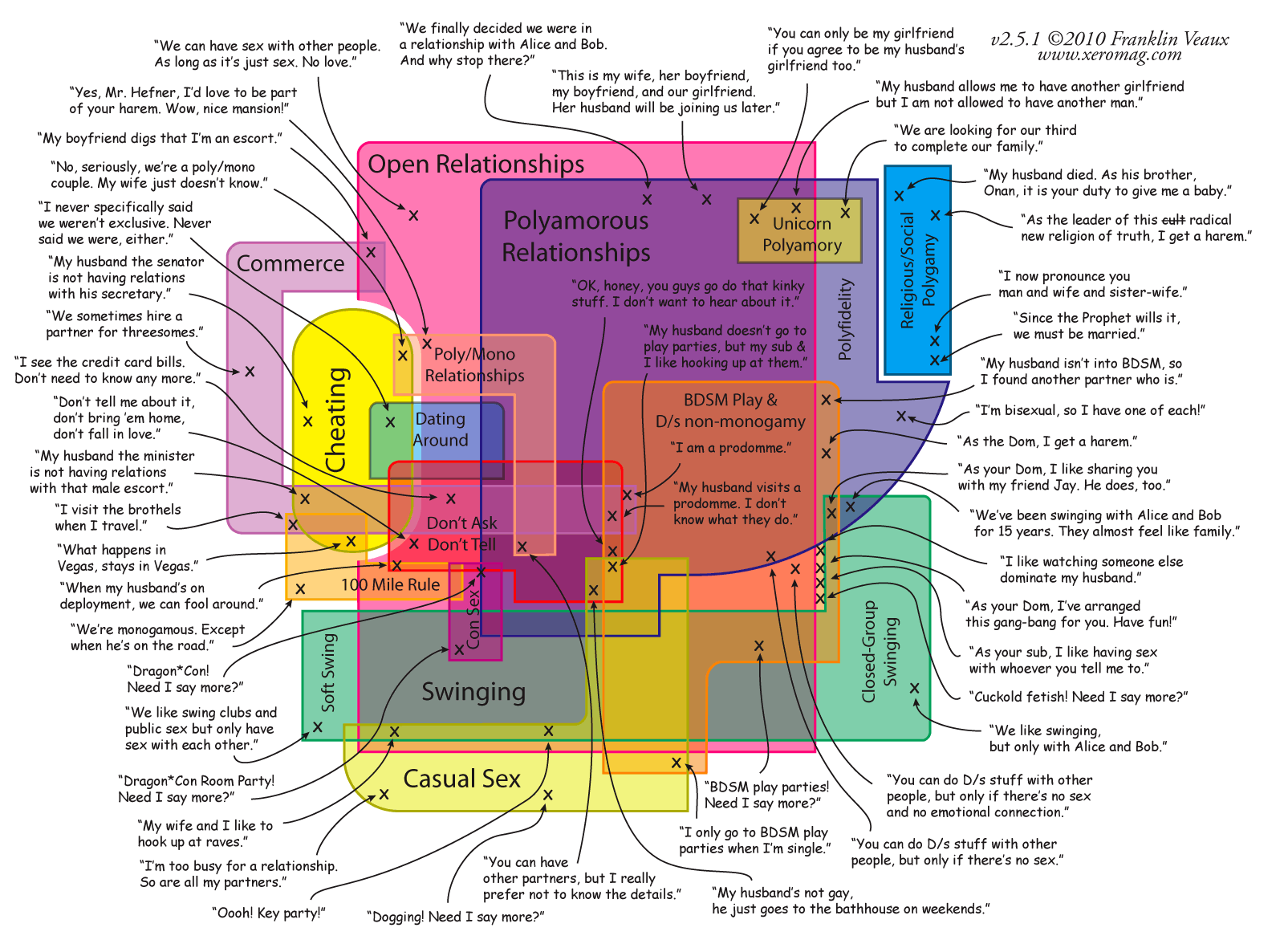
Each relationship can be shaped by the people involved in it. That is why it can be helpful to think of Ethical Non-Monogamy as a map with many possible paths, rather than a manual.
As Franklin Veaux, author of More Than Two, describes in his updated version of The Map of Non Monogamy, there are countless ways to practice love and Ethical Non-Monogamy, and most people exist somewhere in between the well known categories.
To sum up
Ethical Non-Monogamy is not about having more. It is about choosing honesty over secrecy, freedom over expectation, and presence over norms.
It can take many different forms, and that is exactly why curiosity, communication, and consent are the most important tools, no matter what your relationship looks like.